Understanding Headspace
. . . . the rest of the story
The term headspace means the "space" between the "head" of your case and the breech. This
space (clearance) is set when your barrel is installed. Handloaders should minimize the chamber clearance that their handloads have in their chamber.
This limits forward movement of the cartridge when it gets hit by the firing pin. Factory "belted" ammo is designed to let the belt stop any forward movement
of the case. Factory "rimmed" ammo is designed to have the rim stop any forward movement of the case. Factory "non-rimmed" ammo is designed to have the
shoulder stop any forward movement of the case. (Of course there are exceptions.)
Regardless of how factory loads fit your chamber, handloads should always have minimum shoulder clearance. Most reloaders commonly
refer to chamber clearance as "headspace". However, the term "headspace" actually makes things a bit confusing for some people. For handloading purposes,
the term headspace means any chamber clearance that allows your cartridge to move or expand forward or rearward. There's no need to make things more complicated
than that.
 The picture at the left shows where to measure chamber clearance when comparing your handloads to a fired case. This area
needs to be resized just enough to ensure a reliable fit in your chamber. A resized case also needs to be long enough to prevent excessive stretching when it
is fired. If there is too much shoulder clearance, a case will stretch enough to crack just above the web. These cracks can easily be avoided. During
firing, cases expand tightly against the chamber wall. This seals the high chamber pressure during firing and prevents hot gas from blowing back through the action.
If a case ruptures it can be a safety hazard for the shooter and for bystanders.
The picture at the left shows where to measure chamber clearance when comparing your handloads to a fired case. This area
needs to be resized just enough to ensure a reliable fit in your chamber. A resized case also needs to be long enough to prevent excessive stretching when it
is fired. If there is too much shoulder clearance, a case will stretch enough to crack just above the web. These cracks can easily be avoided. During
firing, cases expand tightly against the chamber wall. This seals the high chamber pressure during firing and prevents hot gas from blowing back through the action.
If a case ruptures it can be a safety hazard for the shooter and for bystanders.
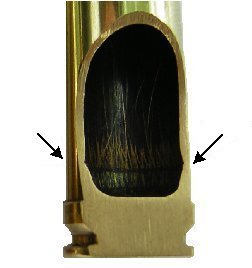
The enlarged picture at the right shows a cutaway view of a belted magnum case. It was reloaded a few times with excessive shoulder clearance.
You can see inside the case, where it has stretched to the point that it is now very thin. The arrows show where case
stretching is the worst - just above the web. If a case is going to crack from a headspace problem, this is where it will usually occur. Cases with this
wear should be discarded, because they are likely to crack (or even rupture) on the next firing. You should always examine this area inside your cases before reloading.
Some handloaders use a sharpened spring hook or even a paperclip to reach in and "feel" the amount of wear in this area. I prefer to measure this wear, and
when it measures - .002" you can consider the case to be unsafe.
 Case head separation is much more common with belted magnum calibers. This is partly because ammunition manufacturers always
make their belted magnum loads to headspace on the belt. They also leave the shoulder extremely far from contacting the chamber (sometimes as much as
- . 020" to - . 030"). This causes the first firing of belted cases to stretch quite a lot. Your very first firing has now stretched
your case considerably, and this weakens cases at the expansion ring.
Case head separation is much more common with belted magnum calibers. This is partly because ammunition manufacturers always
make their belted magnum loads to headspace on the belt. They also leave the shoulder extremely far from contacting the chamber (sometimes as much as
- . 020" to - . 030"). This causes the first firing of belted cases to stretch quite a lot. Your very first firing has now stretched
your case considerably, and this weakens cases at the expansion ring.
The good news is that further case wear can be minimized by controlling chamber clearance at the shoulder, just as you would for any
rimless caliber. Our Belted Magnum Collet Resizing Die extends case life by resizing the brass directly inward, and then only when a little extra
resizing is required. It is still important to inspect your cases for thinning above the web.
The only rifle cartridges that ever actually required a belt are the .300 H&H Magnum and the .375 H&H Magnum. Because of their
extremely shallow shoulder angle, these two calibers actually need a belt to prevent the case from being pushed forward. As you can see on the cutaway
case, the belt is located around the "solid" portion of the case, and it obviously adds no strength to the case whatsoever. In the decades that followed, the
belt was added to over 20 different calibers purely for marketing reasons. Firearm manufacturers figured that if any new magnum caliber didn't have a belt (like
the H&H cases) it would never sell. In fact . . . . if these 2 calibers weren't such incredible performers (in the early days) there wouldn't be ANY
magnum calibers using a belt today.
Most shooters that reload belted magnums notice a slight case bulge that forms "just above" the belt. This can happen after
just 2 or 3 reloadings - wasting perfectly good cases. Many shooters first assume that their cases aren't getting resized enough when their handloads begin
to stick or even fail to chamber. Their first thought is that these cases must be too long. This is where some adventurous shooters make the mistake
of grinding material from the bottom of their dies. However, it's easy to prove with a set of calipers that this is really a case "width" problem just above the
belt. This problem is now easy to resolve with our Belted Magnum Collet Resizing Die.
In order to resize the body on most belted cases, your resizing die needs to firmly contact the case, and then forcibly squeeze downward
almost .100" beyond that point. This is required just to reduce .001" from the diameter of a tapered case, because brass will spring back
slightly. Conventional resizing dies can't travel far enough down a "belted" case. Depending on the size of your die (compared to the size of your
particular chamber), brass can also get plowed rearward against the belt - especially if you're over-resizing the case with a small base die.
Most case bulge problems are caused by "thinned brass" that bulges during any downward pressure on the case when reloading.
Most belted calibers develop a slight case bulge because of repeated case stretching that is made worse by severe wear from the initial firing. That's why I
designed the Belted Magnum Collet Resizing Die to compress the case only inward, and all the way down to the belt. This ensures a reliable, perfect fit in
your chamber. It also extends case life by reducing the bulge that keeps handloads from chambering properly.
The case bulge problem is made even worse by reloaders that don't reduce their chamber clearance at the shoulder. Remember, when a
case is fired, it stretches to fill your chamber. This repetitive stretching weakens your cases if you don't minimize chamber clearance. You can
read all about our Belted Magnum Collet Resizing Die and our Digital Headspace Gauge on our homepage. These tools both help
ensure a reliable fit in your chamber, and provide much longer case life.